
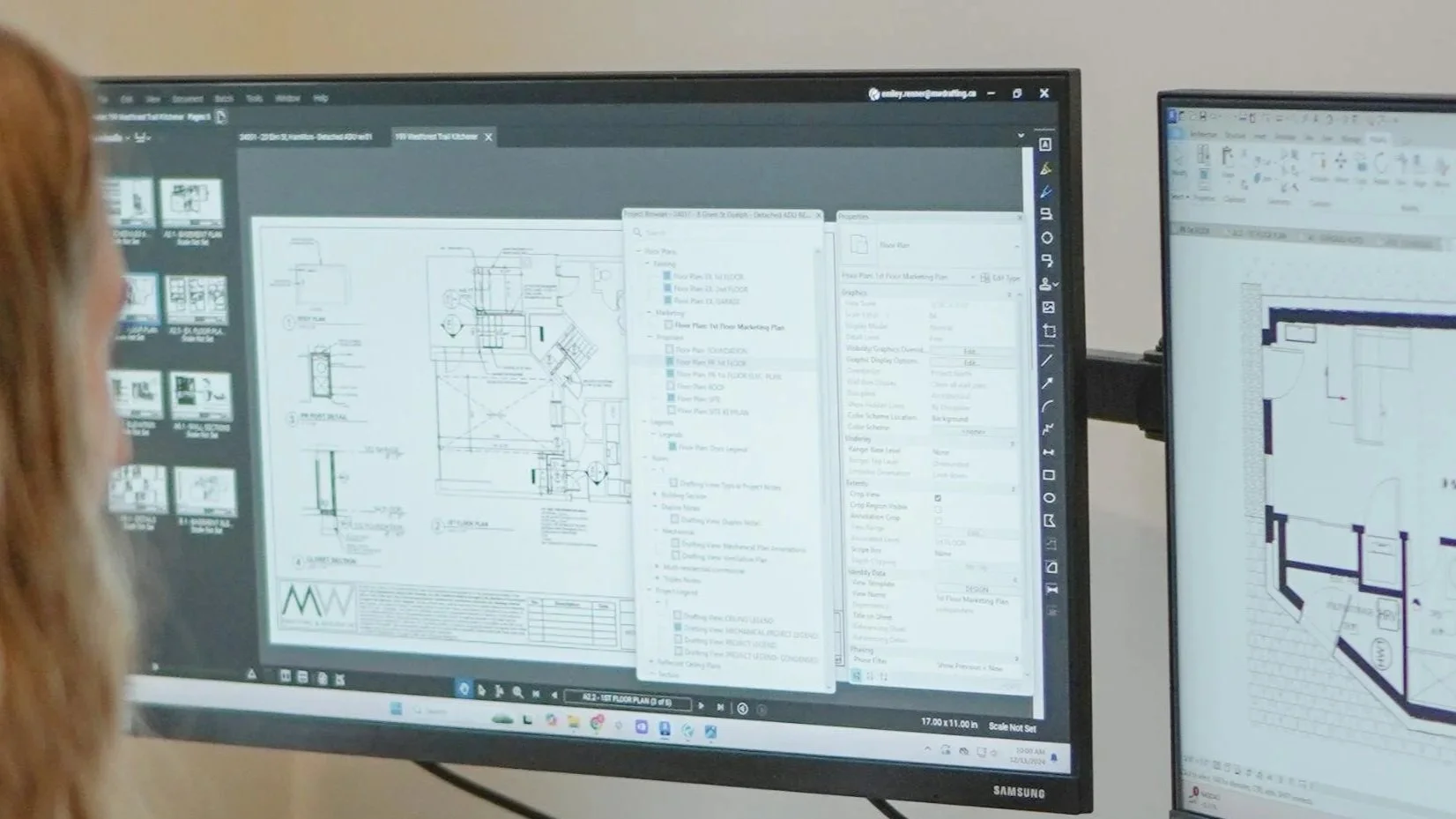
If you require building permit drawings in Ontario for a residential, multi-residential or commercial renovation, addition, secondary suite, accessory dwelling unit (ADU), or new build — whether you’re a homeowner, contractor or investor — it’s important to know exactly which drawings and what details (very SPECIFIC details, that is) the municipality will require before issuing a building permit. Submitting an incomplete drawing set can delay your project, result in a headache-inducing back-and-forth with the building department, or even a refusal.
We created this guide to break down the typical requirements for building permit drawings in Ontario. As a BCIN-certified design firm, MW Drafting & Design specializes in producing full, code-compliant building permit drawings that Ontario municipalities accept — helping you get permit approval smoothly and efficiently.
Standard Drawing Types for Building Permit Applications
Municipalities across Ontario commonly require the following drawings — whether you’re building a new home, doing an addition, building a new multi-residential complex, a commercial build or leasehold improvement, or creating a secondary suite/ARU/ADU. Requirements may vary slightly depending on the project type and municipality, but this checklist covers the standard set.
Site Plan / Property Plan
Shows property boundary lines, lot dimensions, property address, street name.
Includes all existing buildings and proposed new structures with coordinates and setbacks to property lines.
Shows driveways/vehicle access, pathways, parking, and location of existing utilities or services (e.g. septic, well, municipal water/sewer) — if applicable.
For some projects, a lot-grading & drainage plan or elevation / grade-level plan may be required to show drainage, finish floor elevations, and how site drainage will work after construction.
Floor Plans (all levels affected)
Fully dimensioned layout for each floor (existing and proposed) showing walls, partitions, door/window locations, plumbing fixtures, staircases, and proposed uses.
Indicate structural elements, framing layout (if applicable), wall and floor assemblies, floor levels, and finished floor elevations.
For secondary suites / ADUs: show separate living unit layout if adding another dwelling unit within existing home or building a new one.
Foundation / Basement / Structural Plans
If you’re building a new structure, addition, or an ADU/ARU, the foundation or basement plan shows footings, wall types, slab, columns/piers, beams, and structural layout.
Structural details, framing plans, floor joists or roof truss layouts — especially if using engineered components — may also be required.
Elevations (Exterior Views)
Drawings of each external side of the building showing existing and proposed conditions: finished floor levels, rooflines, window/door locations and sizes, exterior finishes and cladding, overhangs/eaves, chimneys or venting, exterior stairs, decks, railings, etc.
Show building height relative to grade — to ensure zoning compliance (height limits, roof slope, natural grade).
Sections & Cross-Sections
Vertical “slices” through the building showing relationships between floors, ceiling/floor heights, foundation to roof assemblies, stairs, landings, deck connections — crucial to demonstrate compliance with structural, fire separation, and Building Code requirements.
Show existing vs proposed structural elements if it's a renovation or addition (what stays vs what changes).
Roof Plan
If building a new roof, addition, or accessory structure — you may need a roof plan showing slopes, ridges/valleys, roof materials, ventilation, skylights, roof drains or eavestroughs, and structural layout for roof framing/trusses.
Mechanical / HVAC, Electrical & Plumbing Plans (if applicable)
For many projects — especially substantial renovations or new builds — municipalities expect mechanical plans showing heating/ventilation, ductwork, HVAC layout, plumbing fixture locations, and sometimes energy-efficiency compliance details.
Electrical layout and wiring, plumbing, and where relevant, fire protection systems (sprinklers, alarms) may also be part of the required package.
Supporting Documents & Compliance Info
Many municipalities require that drawings be stamped, signed, and dated by a certified designer, architect or engineer — especially for large builds, additions, or multi-units.
A building permit application form, property deed or proof of title, and sometimes proof of survey/registered plan are required.
For lots with grading or complex drainage, engineered grading plans or stormwater calculations may also be required.
Why Submitting Complete, Professional Drawings Matters
Code & Zoning Compliance: Permits are approved only if drawings show compliance with the relevant municipal Zoning By-law, property setbacks, lot coverage, height restrictions, site grading, structural safety, fire code, etc.
Avoid Delays & Revisions: Omissions often result in rejection or request for changes, which delays the permit process. Professional drawings minimize back-and-forth.
Legal & Safety Assurance: Detailed plans ensure the final construction is structurally sound and safe, and meets code requirements for framing, load-bearing, egress, fire separation, ventilation, etc.
Clear Communication for Contractors: Contractors rely on permit drawings — clear, accurate, and well-detailed plans reduce misunderstandings, change orders, and cost overruns.
Why MW Drafting & Design Is a Smart Choice for Building Permit Drawings in Ontario
When you hire MW Drafting & Design, you get much more than neat drawings. You get:
BCIN-certified, permit-ready plans tailored to Ontario municipalities and Building Code.
Full-service design support including site-plan layout, floor plans, structural coordination, mechanical/ plumbing/ electrical coordination, latch-on additions, ADUs, secondary suites, or new builds.
Zoning and code expertise — we stay up to date with Ontario Building Code requirements, municipal zoning, fire code, energy compliance (as applicable), and help avoid common pitfalls.
Comprehensive documentation — from structural details and cross-sections to mechanical plans and compliance checklists — ensuring your permit application is complete and professional.
Efficiency and reliability — with over 1,000 successful projects, our team understands how to present drawings so municipalities approve them with minimal fuss.
Whether you’re building a basement suite, an ADU, a new house, addition, or multi-residential project, we handle everything — saving you time, stress, and costly revisions.
Summary: Permit-Ready Drawing Checklist
When you apply for a building permit in Ontario, make sure your drawing set includes at least:
Site Plan (with lot lines, setbacks, existing & proposed buildings, driveway, services)
Lot / Grading & Drainage Plan (if required)
Full Floor Plans for every affected level (existing & proposed)
Foundation / Structural Plans (footings, framing, foundation walls) — when applicable
Elevations (all exterior sides) showing building height, rooflines, cladding, windows/doors, decks/stairs
Roof Plan (if adding or altering roof)
Cross-Sections / Sections showing structural assemblies, floor-to-ceiling details, stairs, etc.
Mechanical / HVAC, Plumbing, Electrical plans (when required)
Signed / stamped drawings by a qualified designer / BCIN / engineer / architect (as needed)
Supporting documentation: permit application, deed/title, survey/plan, building code compliance statements, etc.
If you require building permit drawings in Ontario — whether in Kitchener-Waterloo, Cambridge, Guelph, Hamilton, London, Norfolk, Haldimand, Brantford or beyond — and need professional, code-compliant designs for your residential or commercial project, MW Drafting & Design is ready to help.
Contact us to get started with a full drawing package and navigate your permit application with confidence.